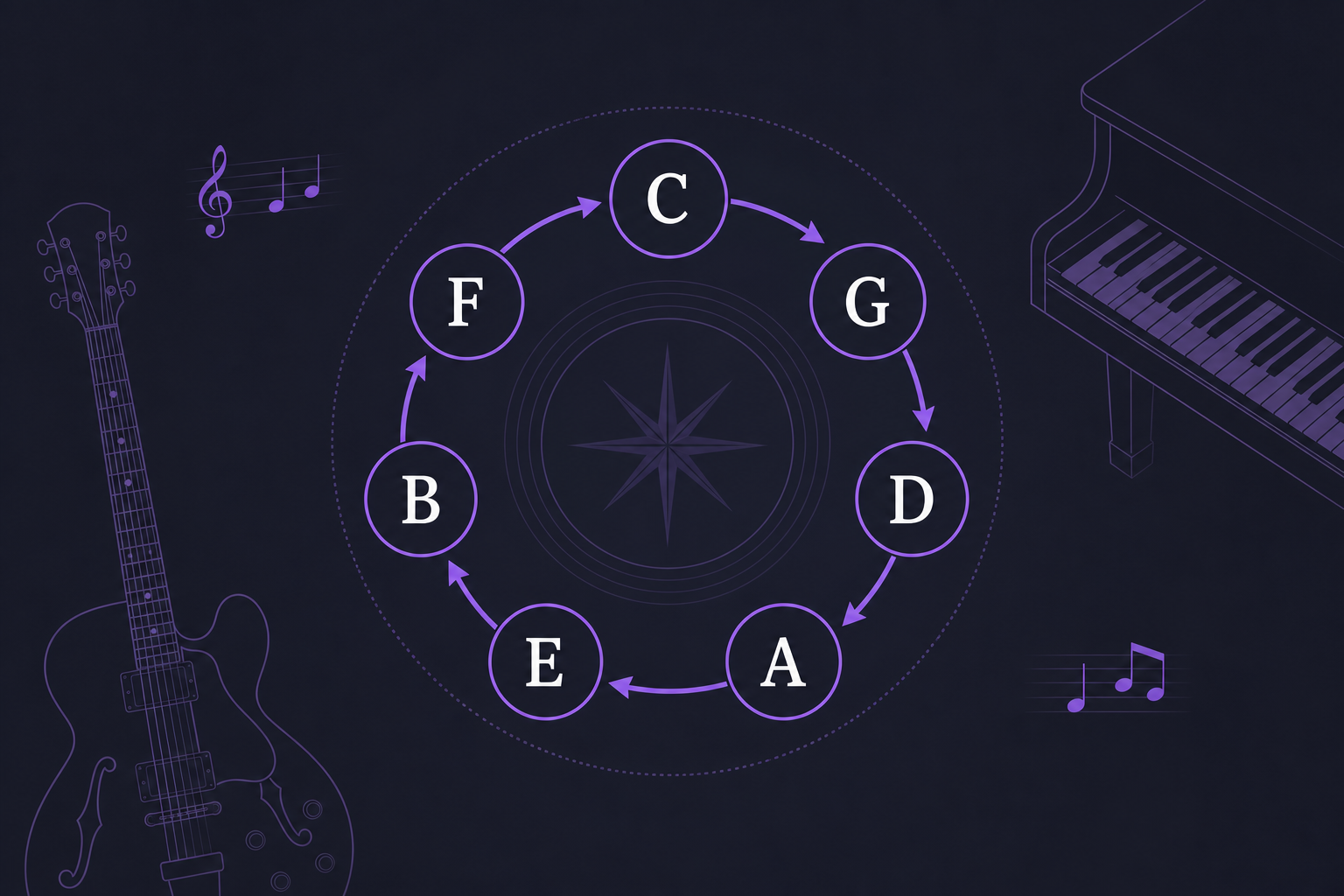
If you have ever wondered why G major feels natural after C major, or why so many songs use the same four chords, the circle of fifths is the answer. It is not just a poster on a music classroom wall — it is a working tool for choosing keys, building progressions, and understanding what chords belong together.
On ChordForge AI Chord Studio, you pick a root key and scale in the sidebar. The circle of fifths explains why those chord options sound coherent — and helps you transpose songs intelligently instead of guessing.
What is the circle of fifths?
Imagine all twelve major keys arranged in a circle. Moving clockwise, each step goes up a perfect fifth (C → G → D → A → E → B → F# …). Moving counter-clockwise, each step goes up a perfect fourth — which is the same as going down a fifth.
Adjacent keys on the circle share most of their notes. That is why modulating (changing key) between neighbors sounds smooth, while jumping to distant keys sounds dramatic.
The shortcut guitarists use
You do not need to memorize the entire circle on day one. Start with this clockwise chain from C:
- C → G → D → A → E → B
Each arrow is a fifth up. The chords built on those roots are the backbone of countless pop, country, and rock songs. In C major, the diatonic chords are C, Dm, Em, F, G, Am, Bdim — and G (the fifth degree) is the dominant chord that wants to resolve back to C.
How it connects to chord progressions
Common progressions often move by fifths because the ear expects that tension and release:
- I – V – vi – IV (pop classic in C: C – G – Am – F)
- ii – V – I (jazz turnaround — the ii and V sit a fifth apart from the target)
- vi – IV – I – V (epic cinematic feel)
In Chord Studio, try the Jazz Turnaround or Pop Preset styles under different root keys. Watch how the Roman numerals stay the same while the actual chord names rotate around the circle.
Relative major and minor
Every major key has a relative minor that shares the same key signature. C major and A minor use the same notes. On the circle, relative pairs sit next to each other. When a song flips between major and minor sections, it is often hopping between relatives — not random mood swings.
Practical uses today
Choosing a key for your voice
If a song is too high in G, move counter-clockwise to C or F — each step removes a sharp or adds a flat, lowering the overall pitch center. Use the root key picker in Chord Studio to audition the same progression in multiple positions.
Writing bridges
Want a bridge that feels fresh but not alien? Modulate to the key one fifth clockwise from your chorus key, then resolve back. The circle tells you which key will feel like a natural detour.
Learning songs faster
When ChordForge AI returns a progression with a detected key, you are seeing the circle in action. A song in E major will favor B and A chords — neighbors on the circle — not random unrelated harmonies.
Circle of fifths vs. chord charts
A chord chart tells you what to play. The circle tells you why it works and what to try next. Together they make you a faster learner: charts for the gig tonight, the circle for the musician you are building long-term.
Explore keys visually in Chord Studio or browse more theory in the Guides hub.
Open Chord Studio