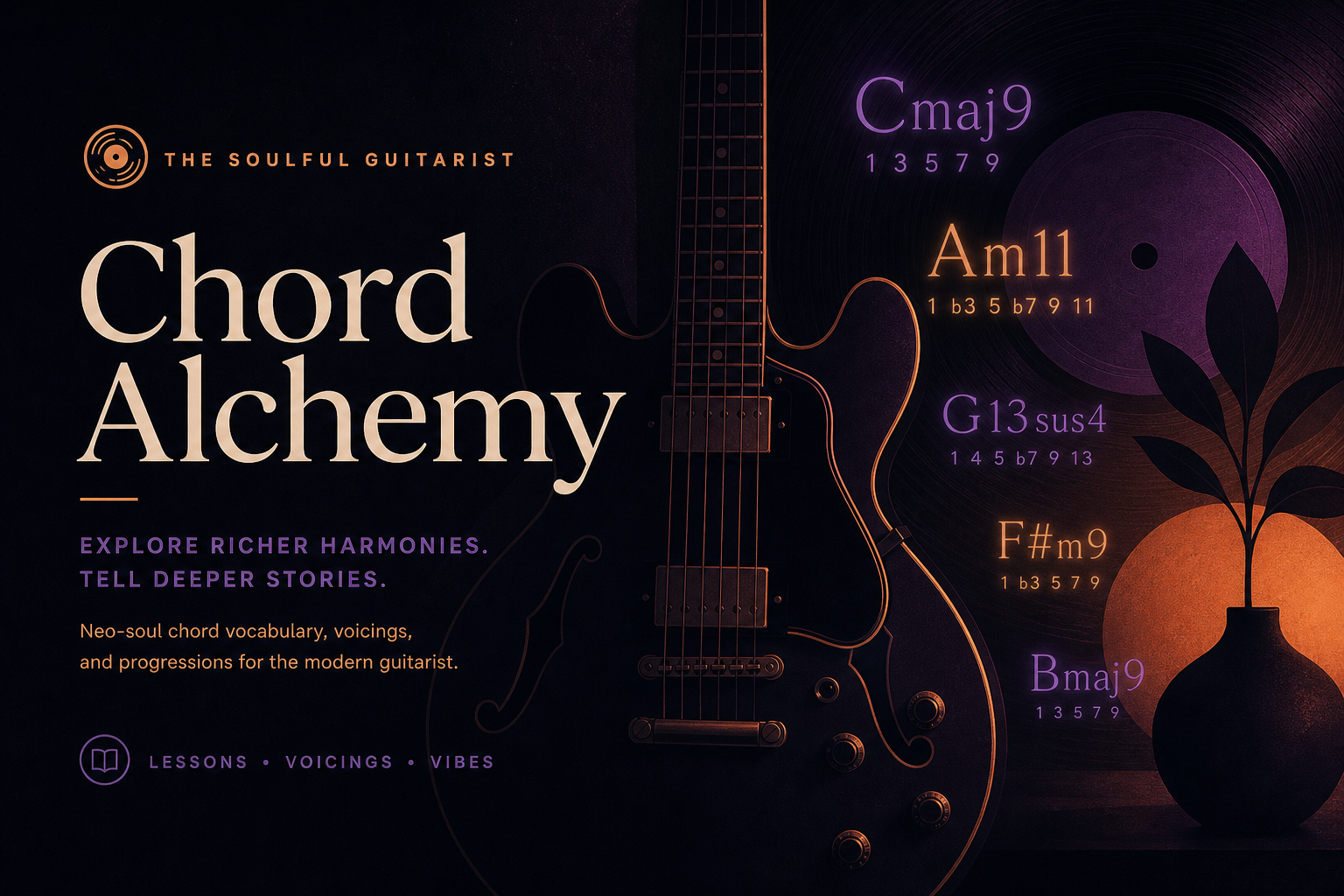
Neo-soul guitar is not about shredding — it is about color, pocket, and voice leading. Artists in this space (think D'Angelo, Erykah Badu, Daniel Caesar, modern bedroom R&B producers) use chords that sound sophisticated but often sit comfortably under the fingers once you know the shapes.
ChordForge AI includes an R&B Neo-Soul progression preset (I – vi – ii – V) and Pro AI generation for jazzier extensions. This guide connects the theory to what your hands actually do.
The neo-soul chord palette
Start with these four qualities — they cover most entry-level neo-soul jams:
- maj7 — lush, settled home base (Cmaj7, Fmaj7)
- m7 — smooth minor color (Dm7, Am7)
- m9 — deeper minor with a hip, modern top note
- dominant 9 or 13 — tension that resolves with style (G9, G13)
Open Chord Studio, select the Neo-Soul preset, and cycle chord cards while listening to how each extension changes the mood without changing the song skeleton.
Why the ii–V–I matters
Jazz DNA runs through neo-soul. The ii–V–I (in C: Dm7 – G7 – Cmaj7) is the most important three-chord sentence in the style. The ii chord sets up tension, the V chord intensifies it, and the I releases it — but in R&B you linger on each chord longer and let the groove breathe.
Try the Jazz Turnaround style in Chord Studio, then slow the progression BPM to 70–85. Neo-soul lives in slow tempos where every extension rings.
Rhythm: chords as percussion
Your fretting hand chooses harmony; your picking hand defines the genre. Common approaches:
- Muted scratches on beats 2 and 4 for pocket
- Single-note fills between chord stabs using chord tones only
- Let ring — hold maj7 chords open and avoid choking them early
Use the free ChordForge Metronome at 75 BPM. If you rush, the chords lose their weight. If you drag, the groove dies. Aim for boring, perfect consistency first.
Voice leading on guitar
Neo-soul players move the smallest distance between chords — one finger slides, one note changes. That is voice leading. In Chord Studio Pro, fingering overlays show which finger stays put and which moves — invaluable when learning shapes that are not plain open chords.
Example in C: move from Cmaj7 (x3545x) to Am7 (5x555x) by keeping common tones ringing instead of jumping to a new grip far up the neck.
A starter progression to learn
In the key of Eb major (common neo-soul key — warm, vocal-friendly):
- Ebmaj7 — 4 bars
- Abmaj7 — 2 bars
- Fm7 — 2 bars
- Bb7 — 2 bars
- Back to Ebmaj7
Set root key to Eb in Chord Studio (use D#), generate or manually step through equivalent chords, and practice with the metronome on beats 2 and 4 accents only.
Using ChordForge AI for neo-soul
With Pro, prompt examples that work well:
- "neo-soul progression in F major, maj7 and m9 chords, slow groove"
- "ii-V-I turnaround in Bb with jazz voicings for guitar"
- "R&B bedroom pop chords, minimal movement, 6 chords max"
The AI returns sectioned progressions with detected key. Click each card, switch to piano view for voicing ideas, then back to guitar for performance grips.
What to practice this week
- Day 1–2: maj7 and m7 shapes in one key, 70 BPM
- Day 3–4: ii–V–I in two keys
- Day 5: One Pro-generated progression, memorize the first eight chords
- Day 6–7: Play along with a recording — timing only, no solos
Build your neo-soul vocabulary in Chord Studio — start with the R&B preset or go deeper with Pro AI.
Open Chord Studio