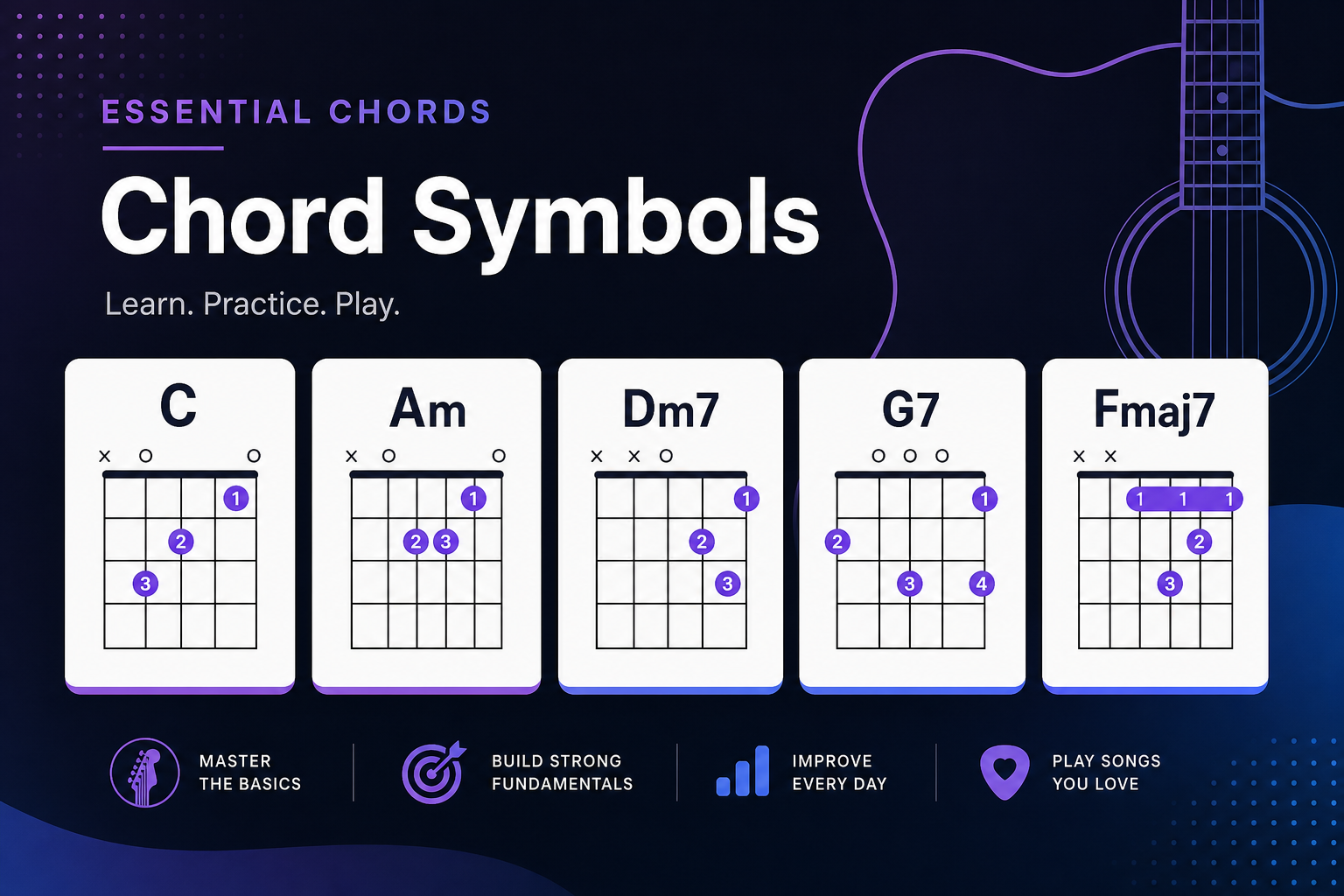
Whether you are reading a lead sheet, a ChordForge AI progression, or a scribbled set list, chord symbols follow consistent rules. Once you learn the pattern root + quality, new symbols stop being intimidating.
The basic formula
Every symbol starts with a root note (C, F#, Bb, etc.), then adds a quality that tells you which intervals to stack on top. No extra text usually means major. Everything else is an abbreviation.
Core chord types
Major — C, Cmaj, CΔ
Bright, stable sound. Built from root, major third, perfect fifth. In Chord Studio this appears as C Maj on chord cards.
Minor — Cm, Cmin, C-
Darker color from a lowered third. The sad or moody chord in most pop ballads. Written C Min in the studio.
Seventh — C7 (dominant)
Major triad plus a flattened seventh. Creates tension that wants to resolve — the classic blues and jazz pull. Not the same as Cmaj7.
Major seventh — Cmaj7, CΔ7, CM7
Major triad plus the major seventh. Dreamy, R&B, neo-soul color. Hear it in opening chords of many Stevie Wonder-style grooves.
Minor seventh — Cm7, C-7
Minor triad plus flattened seventh. The workhorse of funk, jazz, and R&B comping. Often the ii chord in a ii–V–I.
Less common but important
- dim / ° — diminished; every interval tight, unstable (Bdim in C major)
- aug / + — augmented fifth; tense, rising feel
- sus2 / sus4 — replaces the third with the 2nd or 4th scale degree; open, unresolved
- add9, add11 — adds a note without implying a full seventh chord
- / bass note — slash chord; e.g. D/F# means D major with F# in the bass
Reading extensions (9, 11, 13)
Jazz and neo-soul charts stack higher numbers: Cmaj9, G13, Am11. The number tells you how far up the scale the chord reaches, assuming the lower chord tones are still implied. You do not have to play every note — guitarists voice the color notes that fit the groove.
With ChordForge Pro, you can ask the AI for extended voicings and see them mapped on the fretboard and piano — including Pro-only fingering hints that show which finger plays each note.
Sharps, flats, and spelling
Charts use sharps or flats depending on the key context. Eb and D# are the same pitch but different spelling. ChordForge normalizes notes for playback while displaying musician-friendly labels (Db instead of C# where conventional).
From symbol to fretboard
Reading the symbol is step one. Step two is finding a playable grip. In Chord Studio:
- Click any chord card in your progression
- View the guitar or piano visualizer
- With Pro, read the fingering strip above the keyboard — left/right hand for piano, finger numbers on each fret for guitar
Common beginner mistakes
- Confusing C7 (dominant) with Cmaj7 (major seventh)
- Assuming m means mute — it always means minor
- Ignoring slash bass notes and wondering why the bass player plays something different
- Trying to grab every extension on guitar instead of picking a clean 3–4 note voicing
Decode symbols in real time — open Chord Studio and click through any progression, or generate new charts with AI.
Open Chord Studio